Emergency Escape & Panic Door Hardware: BS EN 179, BS EN 1125 and BS EN 13637 Explained

0 min read
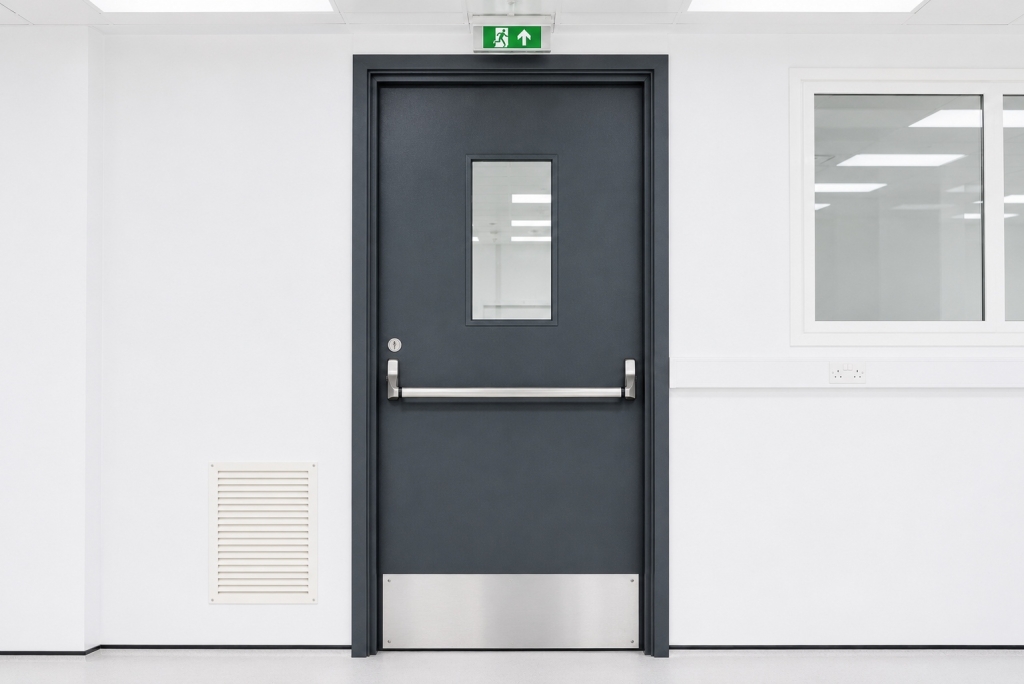
What is the difference between BS EN 179, BS EN 1125 and BS EN 13637, and which standard applies to your escape door specification?
Emergency escape and panic door hardware must allow building occupants to exit quickly and safely in an emergency, without requiring a key, code or specialist knowledge.
For architects, specifiers and contractors, selecting the appropriate hardware means considering the building’s occupancy, fire strategy, escape strategy and security requirements.
Three key British and European standards address different aspects of escape door hardware: BS EN 179 for emergency exit devices, BS EN 1125 for panic exit devices and BS EN 13637 for electrically controlled exit systems.
This guide explains their differences, typical applications and the key specification considerations.
What Are BS EN 179, BS EN 1125 and BS EN 13637?
BS EN 179, BS EN 1125 and BS EN 13637 are product standards covering hardware or systems used to release doors on escape routes.
They establish performance and operating requirements to support safe emergency escape. For conventional emergency and panic exit hardware, a fundamental requirement is that the door can be released from the escape side through a single action, without a key or special knowledge.
However, these standards do not determine:
- The number or location of emergency exits
- Which doors form part of a designated escape route
- The required direction of door opening
These matters must be addressed through the building’s fire strategy, fire risk assessment and applicable regulations and guidance, including Approved Document B and BS 9999 where relevant.
The product standards establish requirements for the escape hardware once the relevant door functions and escape arrangements have been determined.
BS EN 179 vs BS EN 1125 vs BS EN 13637: Key Differences
The principal difference between the three standards is the type of escape hardware or system they cover and the circumstances in which it is intended to operate:
| Standard | Hardware or System | Typical Application | Operation |
|---|---|---|---|
| BS EN 179 | Emergency exit devices | Buildings or areas where occupants are familiar with the escape arrangements and panic is unlikely, such as staff-only areas, plant rooms and controlled workplaces | Lever handle or push pad |
| BS EN 1125 | Panic exit devices | Public buildings or areas where occupants may be unfamiliar with the exits, or where crowding and panic could occur, such as shops, schools and cinemas. | A horizontal push/touch bar across the door |
| BS EN 13637 | Electrically controlled exit systems | Escape doors that must be electrically locked or access-controlled but still release for escape, such as secured entrances and controlled zones. | Integrated electrical locking and release system with a manual override |
BS EN 179: Emergency Exit Devices
BS EN 179 covers emergency exit hardware: a lever handle or push pad that retracts the latch in a single, straightforward action. This requires occupants to deliberately locate and operate the hardware.
This makes BS EN 179 particularly suitable for staff-only offices, plant rooms, smaller commercial units and controlled industrial areas, where occupants are familiar with the building and its escape routes, and panic is unlikely.
What Are the Requirements for BS EN 179 Hardware?
A compliant BS EN 179 emergency exit device must:
- Provide single-action escape: The door must release through one operation, without requiring a key or separate unlocking action
- Be straightforward to operate: Provide a clear, accessible means of escape through a lever handle or push pad
- Meet operating and durability requirements: Release within defined operating forces and withstand the required cycle testing.
- Be the certified device itself: For example, a standard push plate and D-handle are not BS EN 179 devices, as they do not provide a tested single-action escape release.
BS EN 179 devices are available in fire-tested versions, but must be tested and certified as part of the complete doorset, including the door leaf, frame, hinges, seals and closer, to ensure the entire assembly meets the required fire-resistance performance.
BS EN 1125: Panic Exit Devices
BS EN 1125 covers panic hardware: a horizontal push bar (or touch bar) running across an escape door, designed to allow occupants to escape without prior knowledge of the hardware.
The bar must operate across at least 60% of the door width, allowing the door to be released when someone is pushed against it by a crowd, even in dark or panicked conditions.
This makes BS EN 1125 particularly relevant to public buildings, shops, schools, entertainment venues and other locations where occupants may be unfamiliar with escape routes.
What Are the Requirements for BS EN 1125 Panic Hardware?
BS EN 1125 establishes specific requirements for panic exit devices, including:
- Horizontal operation: A horizontal push bar must provide the means of release
- Accessible operating area: The operating bar element must cover at least 60% of the door width.
- Single-action release: Pressure on the operating bar must release the door without a separate unlocking operation.
Why BS EN 179 Emergency Exit and BS EN 1125 Panic Exit Devices are Not Interchangeable
BS EN 179 emergency exit devices require occupants to deliberately locate and operate a lever handle or push pad. In crowded or panicked conditions, this may be difficult.
In contrast, BS EN 1125 panic bars are designed to release the door when pressure is applied to the horizontal bar, allowing it to open even when occupants are pushed against it by a crowd, without needing to locate or deliberately operate a handle.
Specifying BS EN 179 where BS EN 1125 is required is therefore a serious life-safety risk. The building’s fire strategy determines the appropriate hardware based on occupancy, familiarity with the escape route and the potential for panic.
Like BS EN 179 devices, BS EN 1125 panic exit hardware is available in fire-tested configurations for compatible fire-resisting doorsets.
BS EN 13637: Electrically Controlled Exit Systems
BS EN 13637 covers electrically controlled exit systems that allow doors to be secured electronically while maintaining safe emergency escape.
Unlike BS EN 179 and BS EN 1125, which cover mechanical escape devices, BS EN 13637 applies to an integrated system combining electrical locking, control and emergency release.
This makes BS EN 13637 particularly relevant to industrial facilities, secured entrances and controlled areas where unauthorised access must be restricted without preventing occupants from escaping in an emergency.
What Makes Up a BS EN 13637 System?
An electrically controlled exit system includes three principal elements:
- Initiating element: The device used to initiate release by an escaping person, such a request-to-exit pad or a manual emergency release, plus automatic triggers such as the fire alarm
- Electrical locking element: The component securing the door, such as a maglock, electric lock or strike that actually holds the door
- Electrical control element: The controller coordinating the locking, release functions and relevant system inputs
BS EN 13637 electrically controlled exit door systems are typically combined with BS EN 179 or BS EN 1125 escape devices to provide a mechanical means of escape. The appropriate configuration is determined by the project’s fire engineer and fire strategy.
Key Emergency Release Requirements of a BS EN 13637 System
The system must provide the required safe-release behaviour, including:
- Immediate release: The system must release the door immediately upon operation of the emergency release device, except where an approved delayed-egress arrangement applies
- Fire-alarm activation: The system must provide automatic release upon fire-alarm activation
- Fail-safe operation: The system must unlock under power failure or fault conditions
- Manual override: An emergency release must be provided independently of the normal access-control system.
BS EN 13637 also permits delayed egress (time delay) in specific circumstances, allowing a controlled delay between operation of the release device and the door unlocking. The door must unlock automatically after the approved delay, with immediate release in emergencies such as fire-alarm activation or power failure. Such arrangements require approval under the applicable fire safety requirements.
How to Choose the Right Escape Door Hardware
Selecting exit hardware requires consideration of who uses the door, how they are expected to escape and whether additional security or fire-resistance requirements apply.
The following provides an initial specification guide:
| Door Requirement | Specify… |
|---|---|
| Escape door used by familiar staff, where panic is unlikely | BS EN 179 lever or push-pad device |
| Escape door used by the public or unfamiliar occupants, where panic or crowding could occur | BS EN 1125 panic bar |
| Escape door that must be electrically locked or access-controlled | A BS EN 13637 system for the release, plus a mechanical EN 179 / EN 1125 device as required |
| Fire-rated escape door | The fire-tested variant of the above, on the certified complete doorset |
| Door not forming part of an escape route | Appropriate locking hardware (lock/latch) for its intended function, subject to confirmation that the door is not relied upon for escape |
Common Escape Door Hardware Specification Mistakes
Incorrectly specified emergency or panic exit hardware can compromise safe escape and create compliance risks.
Common mistakes include:
- Using a push plate and D-handle as an escape device: These are not certified BS EN 179 devices and do not provide a tested single-action release
- Using a maglock and green break-glass point meet EN 13637 standards: These components alone do not constitute a compliant electrically controlled exit system
- Specifying BS EN 179 where BS EN 1125 is required: A lever handle may be unsuitable where unfamiliar occupants, crowding or panic are expected
- Confusing fire rating with emergency escape: A fire-rated door is not automatically an escape door, and a non-fire-rated door may still form part of an escape route
- Requiring multiple actions to open an escape door: Single-action escape hardware is required; occupants must not need to perform an additional unlocking operation
- Overlooking maintenance: Emergency and panic exit devices require appropriate inspection and maintenance to remain reliable and safe throughout their service life
Key Compliance and Specification Requirements for Escape Door Hardware
Alongside BS EN 179, BS EN 1125 and BS EN 13637 standards, architects and specifiers must consider several wider requirements to ensure escape door hardware is suitable for its intended application:
- UKCA/CE marking and certification: Check and retain applicable conformity markings, Declarations of Performance (DoP) and supporting documentation. Retain the relevant documentation as evidence of product performance and conformity.
- Fire doorset compatibility: Escape hardware installed on a fire-rated door must be supported by appropriate fire-test, certification or assessment evidence for the complete doorset, including the door leaf, frame, seals, hinges, closer and locking device. Hardware should not be specified in isolation.
- Direction of escape: Escape doors serving higher occupancies or higher-risk areas should open in the direction of escape.
- Fire strategy and risk assessment: The building’s fire strategy and fire risk assessment determine which doors are required for escape and which standard (BS EN 179, BS EN 1125 or BS EN 13637) applies.
Escape Door Hardware: Key Terminology
- Emergency exit device: A BS EN 179 lever-operated or push-pad device intended for escape situations where occupants are familiar with the building and panic is unlikely
- Panic exit device: A BS EN 1125 horizontal push-bar or touch-bar device designed for public conditions and to allow escape where panic may occur
- Single-action release: Opening hardware that releases the door through one operation without requiring a key or additional unlocking action
- Fail-safe: A safety-related operating characteristic of electrically locked doors, whereby they unlock automatically upon loss of power or fault, to maintain safe escape
- Complete doorset: The door leaf, frame and associated components forming the tested assembly (fire certification applies to the door set, not a single part), including relevant hinges, seals, closers and locking hardware
- Final exit: A door providing direct access from a building to a place of safety
Need Support With Emergency Escape Door Specification?
Correctly specifying emergency escape and panic door hardware requires balancing safe evacuation, security, fire performance and day-to-day operation.
Tekta provides specialist door and ironmongery specification support for architects, consultants and project teams, helping identify suitable door systems and hardware configurations for demanding industrial and controlled environments.
Through Modus, Tekta’s industrial door specification portal, project teams can also develop coordinated door and ironmongery schedules, bringing functional, compliance and operational requirements together within a structured specification process.
Speak to Our Specification Team
Introductory guidance only. BS EN 179:2008, BS EN 1125:2008 and BS EN 13637:2015 are product standards; the number, location and designation of escape routes and the choice of EN 179 vs EN 1125 vs EN 13637 must be confirmed by the project fire engineer, the fire-risk assessment and the Authority Having Jurisdiction. Hardware must be installed and maintained per the manufacturer’s certified instructions.
MORE FROM TEKTA
- Emergency Escape & Panic Door Hardware: BS EN 179, BS EN 1125 and BS EN 13637 ExplainedWhat is the difference between BS EN 179, BS EN 1125 and BS EN 13637, and which standard applies to your escape door specification? Emergency escape and panic door hardware must allow building occupants to exit quickly and safely in an emergency, without requiring a key, code or specialist knowledge. For architects, specifiers and contractors,… Read more: Emergency Escape & Panic Door Hardware: BS EN 179, BS EN 1125 and BS EN 13637 Explained
- Introducing Modus
 Door specification is complex. Multiple requirements, hundreds of decisions and dependencies between door performance, operation and ironmongery can make producing a comprehensive door schedule challenging. Modus has been developed to bring structure, clarity and confidence to that process. We’re pleased to announce the launch of Modus, the specification portal for the complete door process. Modus… Read more: Introducing Modus
- We’re exhibiting at cold chain live
 Tekta is excited to be exhibiting at Cold Chain Live 2026, taking place on 13–14 October at Telford International Centre. As the flagship event for the UK’s temperature-controlled supply chain, Cold Chain Live brings together more than 400 industry professionals, including cold storage operators, logistics specialists, manufacturers and suppliers. This year’s theme, The Future of… Read more: We’re exhibiting at cold chain live
- UK made cleanroom door
 In pharmaceutical manufacturing, laboratories and cleanrooms, maintaining hygiene, controlling airflow and keeping operations moving efficiently are critical. Tekta’s new UK-made Rapidor Pharma high-speed door has been developed specifically for these demanding environments, combining rapid operation with hygienic construction and excellent air-permeability performance. Designed for cleanrooms, pharmaceutical facilities, laboratories and other controlled environments, the Rapidor Pharma… Read more: UK made cleanroom door